Logo of UNAIDS

Results and 
Transparency Portal

toggle

Main navigation

  • Home
  • Joint Programme
    • UNAIDS in Action
    • 2022-2026 UBRAF
    • UN Reform & the 2030 Agenda
  • Results
    • UNAIDS Results
    • Result Areas
    • Regions
    • Countries
    • Cosponsors
    • Performance Indicators
    • Secretariat
  • Resources and Investments
    • Resources and Investments
    • IATI
  • Donors
    • UNAIDS Resources Mobilization
    • UNAIDS Contributors
    • Evaluation, Audit and Risk Management
  • Documents Library
Search
Filter By:
Strategy/Framework/UN Reform/Reports
Result Area
Regions
Agency
Countries
Content Type
Year
Banner Image of Fully funded, Sustainable HIV response
infoCredit: UNAIDSinfoCredit: UNAIDS
Result Area 8

Fully funded HIV response

HIV Prevention
HIV Treatment
Paediatric AIDS, Vertical Transmission
Community-led responses
Human Rights
Gender Equality
Young People
Fully funded HIV response
Integration and Social Protection
Humanitarian Settings and Pandemics

Fully funded HIV response

Overview
Joint Programme Results
Investments
Resources
Other Resources
Overview

An efficient and fully resourced HIV response including continued international and multilateral support is vital for ending AIDS as a public health threat. A widening funding gap is holding back the HIV response. Approximately US$ 19.8 billion was available in 2023 for HIV programmes in low- and middle-income countries—almost US$ 9.5 billion short of the amount needed in 2025. Total resources available for HIV, adjusted for inflation, are at their lowest level in over a decade. The regions with the biggest funding gaps—eastern Europe and central Asia and the Middle East and North Africa—are making the least headway against their HIV epidemics.

Most funding for HIV comes from domestic resources (about 59%), but both international and domestic HIV funding are under stress. Adjusted for inflation, domestic HIV funding declined in 2023 for the fourth year in a row, and international resources were almost 20% lower than at their peak in 2013. 
 

Source: UNAIDS Financial estimates July 2023
close
Joint Programme Results

The Joint Programme intensified efforts to drive momentum for better resourced and more sustainable national HIV responses in 2025, building stronger national capacities, mobilizing domestic resources and optimizing efficient allocation and using available resources for results. In the context of constrained funding, the Joint Programme provided targeted guidance, tools and strategic information to support evidence-based financing decisions and transition planning, while reinforcing accountability mechanisms to translate political commitments into measurable action.

New normative guidance and analytical instruments were developed and deployed, such as the WHO operational guidance on sustaining priority HIV, viral hepatitis and STI services in a changing funding landscape, as well as the UNAIDS Rapid AIDS Response Financing Tool (RAFT) which helps countries quantify the impact of funding cuts, identify critical gaps and mobilize emergency resources. The Secretariat provided capacity building for RAFT use in 32 countries and in two regional programmes. This enabled governments to model funding freezes and estimate financing gaps, resulting in more informed decision-making and prioritization of interventions. For instance, Malawi allocated US$11 million to hire 6000 health workers, El Salvador directed 28% of its PEPFAR budget to transition actions, and Zimbabwe identified domestic investment needs in response to the financial situation.

Together with partners, the Secretariat developed and promoted the use of tools, policy briefs and methods to support national HIV Response Sustainability Roadmap design and implementation using a two-part framework. Part A, focuses on securing high-level political commitment to the country HIV Response Sustainability vision, establishing high-level outcomes that drive policy, financing and system transformations, along with metrics and institutional frameworks that embed HIV programmes as national priorities. The HIV Response Sustainability Roadmap Part B Companion Guide, which was released in 2025, expanded focus on transition and sustainability planning to help manage funding volatility. The Secretariat provided technical support to 15 countries to complete Part A sustainability roadmaps and nine countries to develop Part B roadmaps, translating commitments into costed operational steps and domestic financing goals. 

By leveraging the political commitment and prioritization framework of the HIV response sustainability roadmaps, several countries have partially or fully implemented targeted mitigation measures and mobilized emergency financing to help sustain essential HIV services during the funding cuts. Countries that developed sustainability roadmaps with Joint Programme support connected requests for one-time emergency funding during the funding disruption to multi-year political commitments to move towards improved self-reliance and sustainability. For example, Uganda increased government budget allocations to HIV and Universal Health Coverage by US$165.4 million for 2025–2026, including US$32.5 million for antiretrovirals. Botswana introduced domestic HIV funding targets for 2026 and 2030, Togo aims to raise domestic HIV funding from 15% to 50% by 2030, and the United Republic of Tanzania committed to financing over half of its HIV response domestically through earmarked levies and taxes.

Resource mobilization and financing evidence were strengthened across regions through support from the Joint Programme. The Secretariat produced global and regional HIV financing estimates for 2010–2024 which were featured in the Global AIDS update and World AIDS Day report, while 2027–2030 resource needs estimates for long-acting PrEP were developed to guide national programmes and partners on ARVs demand forecasting and strategic planning for lenacapavir rollout. The Secretariat also supported national HIV package costing in Viet Nam, Thailand and Mozambique, and provided support to 12 countries in completing National AIDS Spending Assessment reports for evidence-based planning. The World Bank and the Global Fund signed a new memorandum of understanding in December 2025, which built on years of collaboration and committed to mobilize at least US$2 billion over three years for affordable health services, sustainable financing and health products. In Tunisia, UNDP advocacy enabled the Ministry of Health to secure a new US$270 000 budget line for social contracting of HIV services. Through the Scaling Smart Health Systems initiative, UNDP mobilized more than US$15.2 million for integrated health, climate, energy and digital investments, linking HIV, primary health care, diagnostics and resilient infrastructure. 
Joint Programme Specific Outputs 2022-2023
8.1 Advocate for, facilitate access to and guide HIV and related health and development financing mechanisms to advance national frameworks for more sustainable and equitable HIV financing, including integration into expanded pandemic preparedness financing, and related accountability.
8.2 Broaden and deepen the use of innovation, technology and data analytics to improve the impact achieved with available resources; boosting coverage, quality, and equity.

UBRAF Indicator Data

Select year
Investments
UNAIDS Investments in
close
height="500px" scrolling="no">

Resources

  • Reports
  • Infographics
2025-Result-Area-8-report
Jun 2026
2025 Report: Result Area 8 Fully funded, sustainable HIV response
RA8_Report
Jul 2025
2024 Report: Result Area 8 Fully funded HIV response
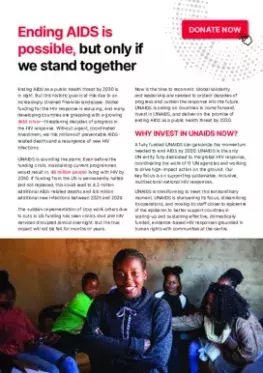
20250603_rmo_appeal_brochure_0
Jun 2025
Help us end AIDS- Donate now
RA08-2022-2023
Nov 2024
2022-2023 Report: Result Area 8 Fully funded, sustainable HIV response
PCB 54_ 2022-2023 PMR Executive Summary
Jun 2024
2022–2023 PMR Executive Summary
2022-2023 PMR Results Report
Jun 2024
2022-2023 PMR Results Report
2022 RA 08_EN_0
Jul 2023
2022 Report: Result Area 8 Fully funded, sustainable HIV response
2022 PMR Executive Summary
Jun 2023
2022 PMR Executive Summary
2022 PMR Results Report
Jun 2023
2022 PMR Results Report
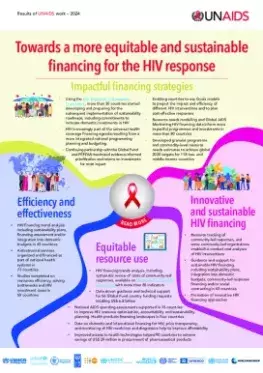
2024_Infographic_Equitable-and-Sustainable-Financing
Jan 2026
Equitable and sustainable financing for the HIV response (2024 Results)
Sustainable-Finance_2024
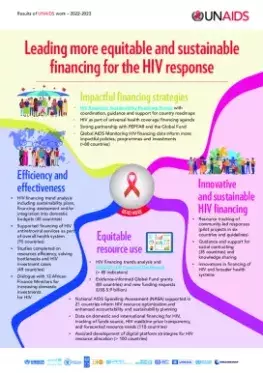
Nov 2024
Leading more equitable and sustainable financing for the HIV response (2022-2023)
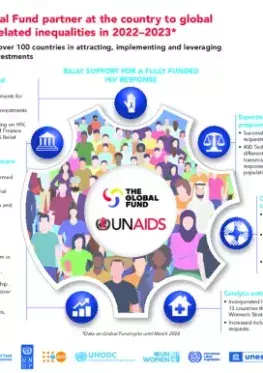
Global-Fund_2024
Nov 2024
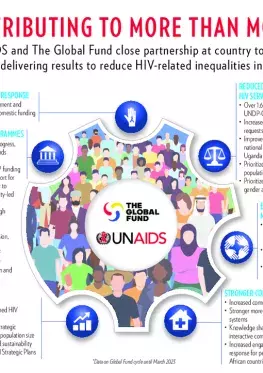
UNAIDS-Global Fund partnership (2022-2023)
2022 Global Fund UNAIDS Collaboration
Sep 2023
UNAIDS-Global Fund partnership (2022)
Infographic Global Fund Partnership - 2020-21 PMR
Oct 2022
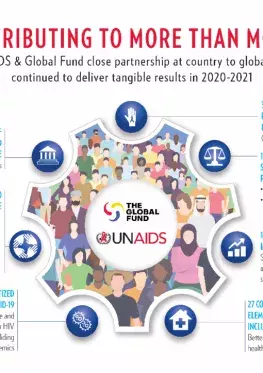
UNAIDS-Global Fund partnership (2020-2021)

Other Resources

Resources and financing for the AIDS response | UNAIDS
New HIV response sustainability approach UNAIDS
HIV response sustainability primer | UNAIDS
HIV Response Sustainability Roadmap — Part A — Companion Guide | UNAIDS
A triple dividend: The health, social and economic gains from financing the HIV response in Africa | UNAIDS
UNAIDS HIV Financial Dashboard
With the right investment, AIDS can be over — A US$ 29 billion investment to end AIDS by the end of the decade | UNAIDS
More than money — The Joint United Nations Programme on HIV/AIDS and the Global Fund to Fight AIDS, Tuberculosis and Malaria | UNAIDS
Logo of UNAIDS
  • X
  • Facebook
  • Instagram
  • YouTube

Copyright © 2024

UNAIDS

  • Report fraud, abuse, misconduct
  • Scam alert
  • Terms of use