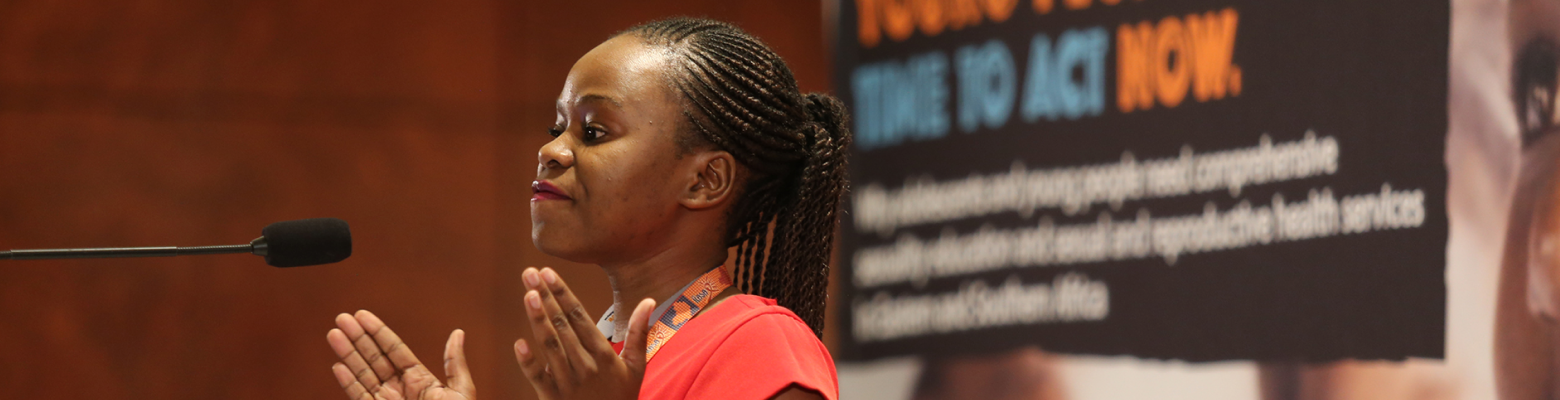
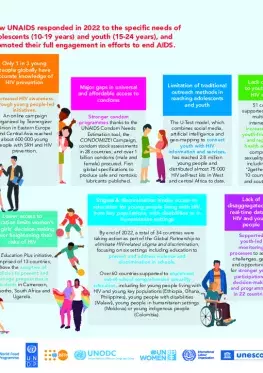
The Joint Programme supported the expansion of youth-friendly HIV services, youth leadership and engagement, and youth-led responses in 2025, including for comprehensive sexuality education (CSE) and sexual and reproductive health. Support spanned global advocacy, institutional and policy frameworks, teacher training, digital innovation and safer school environments.
Global advocacy support from the Joint Programme, youth-led groups and partners, resulted in stronger youth participation, in stronger youth participation, improved operational recommendations, and broader integration of equity-driven approaches in global health. At the High-Level Multisectoral Leadership Dialogue on HIV Prevention during the 78th World Health Assembly, youth-led organizations called for better access to emerging tools and innovations for HIV prevention and secured concrete commitments from Ministers of Health to integrate youth-led priorities into national HIV prevention plans. The Education Plus Initiative's Young Women's Leadership Hub engaged over 80 youth networks globally, culminating in the launch of a global adolescent girls and young women manifesto at ICASA in December 2025. The Global Partnership Forum on Comprehensive Sexuality Education, co-convened by UNESCO and UNFPA, brought together over 70 partners in Mexico City to build capacities and explore strategies for enabling environments for CSE, with a focus on advocacy and youth engagement.
CSE was advanced as a core HIV prevention intervention across all regions. In 2025, UNESCO's support reached 32.6 million learners with life skills-based HIV and sexuality education, including 27.1 million in sub-Saharan Africa through the O3 Programme. In west and central Africa, the Hello Ado social media ecosystem reached 130 000 active users across 20 countries by end of 2025. Digital and peer-led innovations expanded reach to marginalized youth, like in Kyrgyzstan, where the AI-powered "Oilo" chatbot provided confidential HIV and reproductive health information to over 60 000 university students. In eastern and southern Africa, adolescent and youth sexual and reproductive health programmes supported by UNFPA, including digital innovations, expansion of youth-friendly services, economic empowerment and youth leadership engagement platforms, reached over 15 million people.
UN Women implemented HIV programmes for adolescent girls and young women in 14 countries, including in Kenya, Tanzania and Zimbabwe, where mentorship and peer learning programmes resulted in 55 young women leaders influencing HIV services agendas.
From 2024-2025, the World Bank provided external financing support for education in 94 countries, such as through cash transfers in Zambia which reached over 1.3 million households and covered school fees for over 173 000 girls. In addition, over 3.3 million Nigerian girls enrolled in secondary education as part of the World Bank’s Adolescent Girls Initiative for Learning and Empowerment project.
Accountability and multisectoral implementation for adolescent health and well-being, including on HIV, SRH, mental health and gender-based violence were also reinforced through Joint Programme support. In west and central Africa, UNFPA and the Secretariat convened representatives from 25 countries in Togo to validate a harmonized set of accountability indicators, ensuring HIV, gender-based violence, and sexual reproductive health were prioritised for adolescents and youth.